
Suzuki chief Osamu Suzuki, on a visit to India, said that the companies would not only expand operations and production in the domestic market but gradually use it as a base for exports to other regions, primarily Europe.

Appellate tribunal NCLAT on Monday stayed the Rs 200 crore penalty imposed by the Competition Commission on Maruti Suzuki but directed the car maker to deposit 10 per cent of the total amount within three weeks. The amount has to be deposited with the Registrar of the National Company Law Appellate Tribunal (NCLAT). A three-member NCLAT bench stayed the demand notice issued on October 27 to the car maker, subject to the condition of depositing 10 per cent of the penalty amount.

The board of Maruti Suzuki India (MSIL) on Tuesday approved a proposal to issue shares worth Rs 12,841 crore to parent company Suzuki Motor Corporation (SMC) for acquiring Suzuki Motor Gujarat (SMG). The Gujarat manufacturing plant - with an annual capacity of 750,000 units - is owned by SMG, a wholly-owned subsidiary of SMC. The shares issued to SMC will raise its ownership in MSIL from 56.48 per cent to 58.19 per cent--India's largest carmaker stated in a notice to BSE.

The new year will see a line of hatchbacks (including compact SUVs) hit the Indian roads. Rajesh Karkera/Rediff.com offers a peek.

Of the 15 car manufacturing companies in India, eight have a market share of below 2 per cent, raising questions about their long-term future in a competitive market that has already seen Ford Motors and General Motors slam the door on India.

Hyundai got two stars for Grand i10 Nios and Kia got three stars for Seltos.

Corporate India is starting to step up its capital expenditure plans amid government incentives and signs of rising demand, company executives and analysts have indicated. This coincides with the Reserve Bank of India (RBI) recently citing a double-digit growth in private capital expenditure. Healthy balance sheets of banks and corporates, along with increasing capacity utilisation and improving business sentiment, are contributing to a favourable environment for sustained growth in private sector investments, the RBI said in its policy last week.

At a time when exchange-traded funds (ETFs) were unloading Jio Financial Services from their portfolios, some active fund managers were placing large bets on the demerged financial services arm of Reliance Industries Ltd (RIL), a report by Nuvama Alternative & Quantitative Research shows. Motilal Oswal Mutual Fund and Quant Mutual Fund were the top MF buyers of the stock in August. They bought around 60 million shares each, together investing around Rs 2,800 crore.
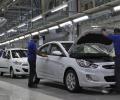
Domestic passenger vehicle sales could touch a record level of nearly 40 lakh units this year on strong demand and companies finding ways to enhance production despite semiconductor shortage, a senior Maruti Suzuki India official said on Monday. Even as the chip shortage issue has improved compared to a year back, the industry is estimated to have a pending order of around 7.5 lakh units of passenger vehicles with Maruti Suzuki India (MSI) alone having around 4.18 lakh units, company senior executive officer, marketing and sales, Shashank Srivastava told PTI. "I think it would be slightly below 4 million (units mark).
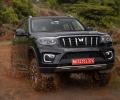
'The decrease in the popularity of white cars and the rise in preference for darker colours like black, grey, and blue over the past three years reflect changing consumer attitudes.'

A clutch of automakers including Maruti Suzuki, Hero MotoCorp, Mercedes Benz India, Eicher Motors, TVS Motor, and Isuzu Motors India announced they had got the clearance from the governments of the states they operate in to resume operations.
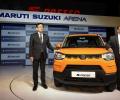
The new model, which is based on the company's fifth generation HEARTECT platform, comes with a BS-VI compliant one-litre petrol engine with a claimed fuel efficiency of 21.7 km per litre.

Maruti Suzukisaid it was trying to offer more factory-fitted CNG cars to address environmental concerns

Operating margins have been the primary driver of corporate earnings in India in recent quarters, despite revenue growth suffering from weak consumer demand. Companies across sectors have reported a sharp improvement in earnings before interest, tax, depreciation, and amortisation (Ebitda) margins over the past two years, benefiting from lower commodity and energy prices. Higher margins more than compensated for slower revenue growth, resulting in double-digit growth in net profit for five consecutive quarters.

Equity benchmarks ended higher on Friday helped by buying in index major Reliance Industries along with fresh foreign fund inflows. Extending its previous day's rally, the 30-share BSE benchmark climbed 203.01 points or 0.34 per cent to settle at 59,959.85. During the day, it jumped 376.33 points or 0.62 per cent to 60,133.17.
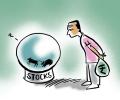
RBI's interest rate decision, macroeconomic data and global trends would dictate terms in the equity market in a holiday-shortened week, analysts said. Besides, the focus will also be on foreign portfolio investors' trading activity, they added. Equity markets will remain closed on Tuesday for 'Mahavir Jayanti' and on Friday on account of 'Good Friday'.
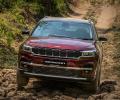
The iconic brand is considering petrol powertrains for its entire Indian portfolio, which includes the Jeep Compass, Meridian, Grand Cherokee and Wrangler.

MSI will inspect certain WagonR models for a possible issue of fuel hose fouling with metal clamp.

Which entrepreneur would willingly part with her or his hard-earned money for grasping, self-serving politicians? asks Debashis Basu.

High cost of acquisition due to a variety of reasons, including higher GST than all other major countries, is slowing down car demand in the country and unless the Centre and states take steps to reduce it, the industry is unlikely to experience reasonable growth, according to Maruti Suzuki India Chairman R C Bhargava. Addressing shareholders in the company's Annual Report for 2020-21, he said after the devastating second wave of the coronavirus pandemic hitting the first quarter of FY22, the performance in the next three quarters will largely depend on how effectively people get vaccinated and observe safety protocols.
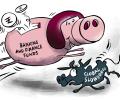
Even as banks and finance companies are reporting record-high earnings, their weighting in the benchmark National Stock Exchange Nifty50 Index has seen a downward trajectory. Investors expect a stronger performance from other sectors in the new year. Currently, banking, financial services and insurance (BFSI) companies collectively hold a weighting of 34.5 per cent, down from 36.7 per cent at the end of December 2022 and a record high of 40.6 per cent at the end of December 2019. This represents the sector's lowest weighting in the index since December 2021 when it stood at 33.7 per cent.

Toyota Kirloskar Motor on Tuesday said it is recalling around 994 units of its recently launched mid-sized sports utility vehicle Urban Cruiser Hyryder to fix a faulty seat belt part. In a statement, the company said it has initiated a voluntary recall campaign for certain Urban Cruiser Hyryder units to investigate for a possible issue with front seat belt shoulder height adjuster plate assembly. Around 994 vehicles of the specified models may have been impacted by this concern, Toyota Kirloskar Motor (TKM) said in a statement.

Maruti Suzuki India is eyeing a leadership position in the SUV segment as it continues to add new products across various sub segments, a top company official said on Wednesday. The country's largest carmaker has bolstered its presence in the high volume entry and mid level SUV segments with new Brezza and all new model -- Grand Vitara. "In every segment except SUV, we are the market leader by a distance. "It is only in the SUV that we are behind, so we need to catch up. Clearly, we have to become number one in the SUV space also," Maruti Suzuki India MD and CEO Hisashi Takeuchi said in an interaction on the sidelines of the global unveiling of Grand Vitara.

The e-SURVIVOR symbolises Maruti Suzuki's commitment to help develop the entire life cycle of EVs in India

Consumer goods firms and auto companies are witnessing an upturn in rural demand, which had been lagging for most of FY24. Expectations of a bumper rabi crop harvest have helped turn the tide. The Reserve Bank of India's (RBI's) Monetary Policy Committee kept the repo rate unchanged last week, noting that as rural demand catches up, consumption is expected to support economic growth in 2024-25.

Watch the flash mob that take over Auto Expo 2018.

The company, whose arm Maruti Suzuki is the largest passenger vehicles maker in India, asserted that it does not align with any political or religious inclination in any part of the world.

Maruti Suzuki India is facing stiff resistance from private sector mutual funds and insurance companies, which own almost 7 per cent of the company, for its decision to allow Suzuki to make cars for the Indian car-maker at a proposed plant in Gujarat instead of manufacturing vehicles itself.

If Tesla comes in, India's position as a manufacturing hub will rise many notches, as it will become only the second country, after China, to have both Apple as well as Tesla.

Leading automakers Maruti Suzuki India, Hyundai and Tata Motors reported a double-digit increase in dispatches to dealers in April as the demand remained robust especially for the sports utility vehicles. The country's largest car maker Maruti Suzuki India (MSI) said its domestic passenger vehicle wholesales rose 13 per cent to 137,320 units last month as against 121,995 units in April 2022. Sales of mini cars, comprising Alto and S-Presso, fell 18 per cent to 14,110 units as compared with 17,137 units a year ago.

The 2024 Kia Sonet facelift impresses with its comprehensive upgrades, ranging from a refreshed exterior design to advanced safety and technological features.

The first major pricing error was made by market leader Maruti Suzuki when it launched its first crossover the S Cross

Investors' wealth climbed Rs 3.20 lakh crore as markets staged a smart comeback on Wednesday after falling in the last eight trading sessions. The BSE Sensex rallied 448.96 points or 0.76 per cent to settle at 59,411.08. During the day, it jumped 513.33 points or 0.87 per cent to 59,475.45.

Maruti is trying to move up the segment by focusing on premium cars, SUVs and even trucks.

Currently, Maruti Suzuki has 14 car brands, but it has decided to expand into some new segments.

Japanese auto major Suzuki Motor Corporation (SMC) on Wednesday said its long-serving chairman Osamu Suzuki will retire and assume the role of senior advisor subject to shareholders' approval in the ordinary general meeting to be held in June this year.

Only five of India's top 20 car models have seen a reduction in wait times over the past year.

The company, which currently sells a range of vehicles from Alto to S-Cross, said it has taken the decision to hike prices due to an increase in input costs. The weighted average price rise, with effect from April 18, in ex-showroom prices (New Delhi) across models is 1.3 per cent, it added.

'From data on enquiries, we can build what we call a data lake or a data warehouse where data is classified into various cohorts and then we use AI and ML tools to predict demand down the line.'

Tata Motors, Ford, Nissan, Maruti Suzuki, Toyota Kirloskar, BMW, Renault and Isuzu have also announced price hike from next month citing impact of increase in commodity prices and foreign exchange rates.
